The Drawer Everyone Avoids
Every house has one. It is never really about the batteries.
The Brant Team · August 20, 2026 · 5 min read
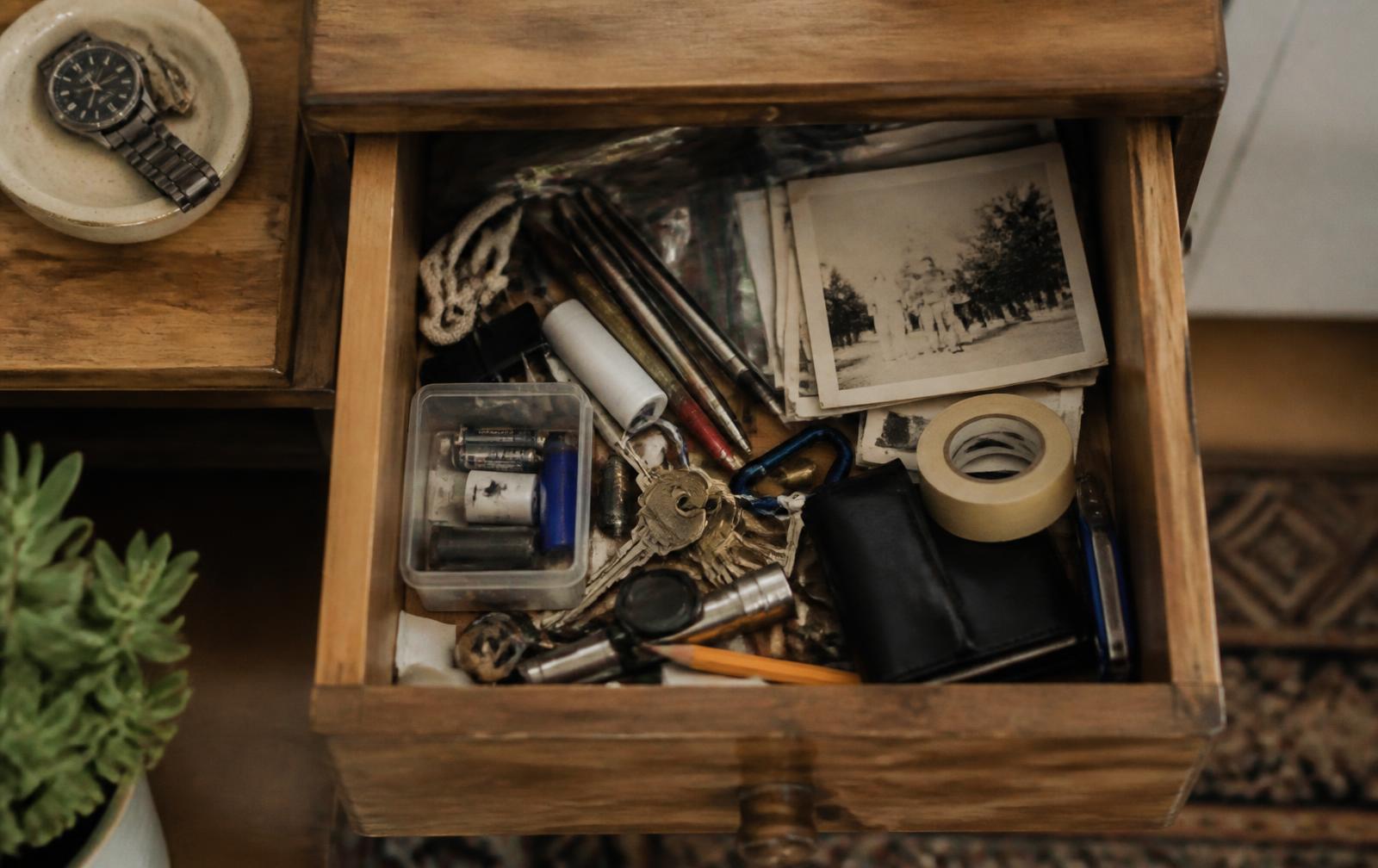
Every house has one. Usually in the kitchen, usually the second drawer down, usually the one that sticks. Inside: three sets of keys that no longer open anything, a tape measure, a flashlight with corroded batteries, a photograph nobody remembers taking, and a small plastic bag of screws saved with such conviction that throwing it away now feels like an insult to the person who saved it.
People are quick to call this drawer chaos. It isn't. It is a filing system built by a household over decades, and it follows one rule: if a thing does not obviously belong anywhere, but might one day matter, it goes here. Which makes the junk drawer the most honest inventory in the house. The living room is arranged for guests. The drawer is arranged for real life.
Why sorting stalls at the second drawer down
Watch a family begin to sort a house — not a dramatic clear-out, just a first pass — and notice where the momentum dies. It is almost never the closet. Closets are easy; clothing announces whether it fits. It is not the pantry either. Expiration dates make those decisions for you.
It is the drawer.
The junk drawer is the last honest room in the house.
Because the drawer is where the unfiled parts of a life ended up, and unfiled things require a judgment nobody has made yet. A single key is not a key. It is a question: what did we used to lock, and do we still own it? A stack of business cards is not clutter. It is a record of who a household once relied on — a plumber, a piano teacher, a doctor who has since retired.
The arithmetic of small objects
There is a strange arithmetic to this. A large decision — sell the house, move closer to a daughter, take the single-story instead of the two-story — can be made in an afternoon at the kitchen table with a legal pad. A small decision, made about a rubber band ball, can take three weeks.
That is not irrationality. Big decisions come with reasons: stairs, upkeep, distance, money, health. Reasons make decisions possible. Small objects come with no reasons at all, only associations, and associations are slippery. You cannot argue with them, and you cannot schedule them.
Which is why the households that get through it are rarely the ruthless ones. They are the patient ones. They open the drawer, take out four things, decide about those four, and close it again. Nobody wins a medal for that. But the drawer eventually empties, and the house behind it becomes possible.
What the drawer is protecting
There is a gentler reading of all this. The drawer is not procrastination. It is a small, private argument that a household is still in motion — that there will be another project, another repair, another use for the odd bracket and the good scissors. To empty the drawer is to concede, quietly, that some of those projects will not happen.
That is a real loss, and it deserves to be treated as one rather than tidied past.
So the advice, if there is any, is smaller than the usual advice. Do not start with the drawer. Start with something that has an obvious answer, and let the drawer wait until sorting has become an ordinary Tuesday activity rather than a referendum on the last forty years. The drawer will still be there. It always is.
- #belongings
- #downsizing
- #memory